
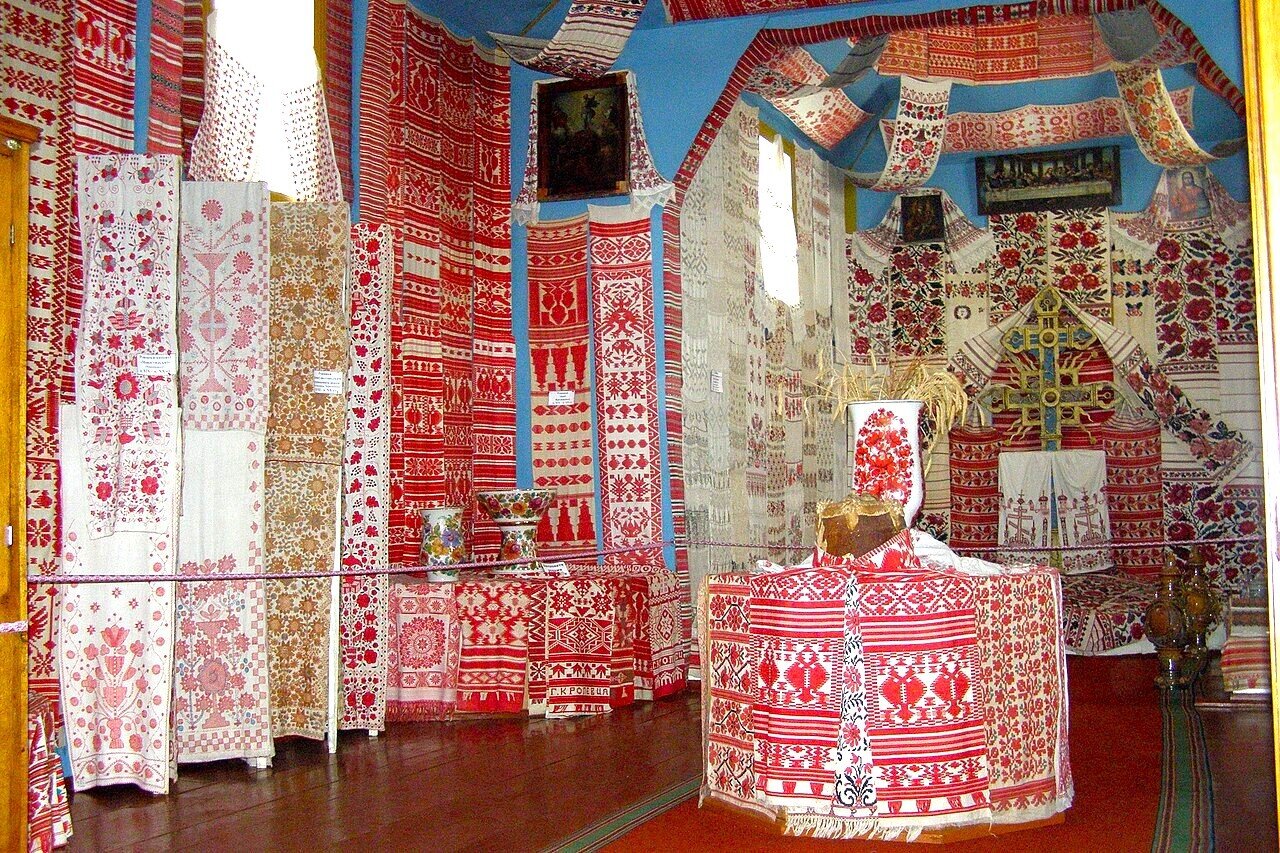
The Museum was established in 1995 in the Church of the Three Saints, built in 1651 and relocated from the village of Pyshchyky in Kyiv region.
The rushnyk (ritual cloth) is a significant symbol of Ukrainian culture, accompanying a person throughout life. Its ornaments contain ancient magical symbols, the Tree of Life, the protective goddess Berehynia, and motifs representing nature and the cosmos.
The museum’s collection includes about 4,000 rushnyks, with 367 featured in the exhibition. These originate from Kyiv, Poltava, Polissia, Cherkasy, and Chernihiv regions.
Of particular value are 19th-century handwoven rushnyks from Pereiaslav, which are iconic examples of Ukrainian folk art. The exhibition also features:
- Polissian rushnyks with horizontal patterns (19th–20th centuries),
- Krolevets rushnyks with protective symbols (19th–20th centuries),
- rushnyks from the Pereiaslav Zemstvo Workshop (early 20th century),
- block-printed rushnyks from the 1930s–1950s,
- modern woven samples from the art factories of Pereiaslav-Khmelnytskyi and Bohuslav (1950s–1980s), including works by folk artists Z. Honcharuk, I. Nechyporenko, and N. Skopets.
The true gems of the collection are embroidered rushnyks from the 18th–19th centuries, made using traditional techniques such as the old Poltava stitch, tambour stitch, various types of openwork embroidery, and cross-stitch.


 Share on Facebook
 Share on X